Key Takeaways
|
The Pacific Ocean covers nearly a third of the Earth’s surface, yet scattered across its waters are island communities with some of the most distinct and tightly kept family histories anywhere in the world. Thanks to 23andMe members who chose to share their stories of Pacific heritage, we recently added 47 new Genetic Groups spanning Oceania, from the Hawaiian Islands to the Mariana Islands, Micronesia, Melanesia, Samoa, Tonga and Fiji. This is the most detailed genetic view yet of Pacific Islander and Native Hawaiian ancestry available to date.
What Are Genetic Groups?
Genetic Groups are part of 23andMe’s Ancestry Composition feature. They’re groups of people who share more recent DNA with one another than with the broader population, typically because their families lived in the same region, often on the same island or archipelago, for many generations. By analyzing shared DNA patterns across thousands of 23andMe members with Pacific heritage, our clustering algorithm can identify specific regional genetic signatures.
This update covers a vast swath of Oceania. It includes:
- Five groups across the Hawaiian Islands, from the Big Island and Maui to Kaua?i and O?ahu.
- Broader regional groups for Melanesian, Micronesian, Polynesian and South Pacific Islander ancestry.
- Specific groups within the Mariana Islands, Palau, the Federated States of Micronesia, the Marshall Islands, Samoa, Tonga and Fiji, in some cases narrowing all the way down to a single island or or even regions within a single island.
Most 23andMe members with Pacific Islander or Native Hawaiian ancestry will see at least one of these groups reflected in their results. In addition, 23andMe+ Premium™ members can dive deeper into their heritage and see if they have any distant Genetic Group connections across this region.
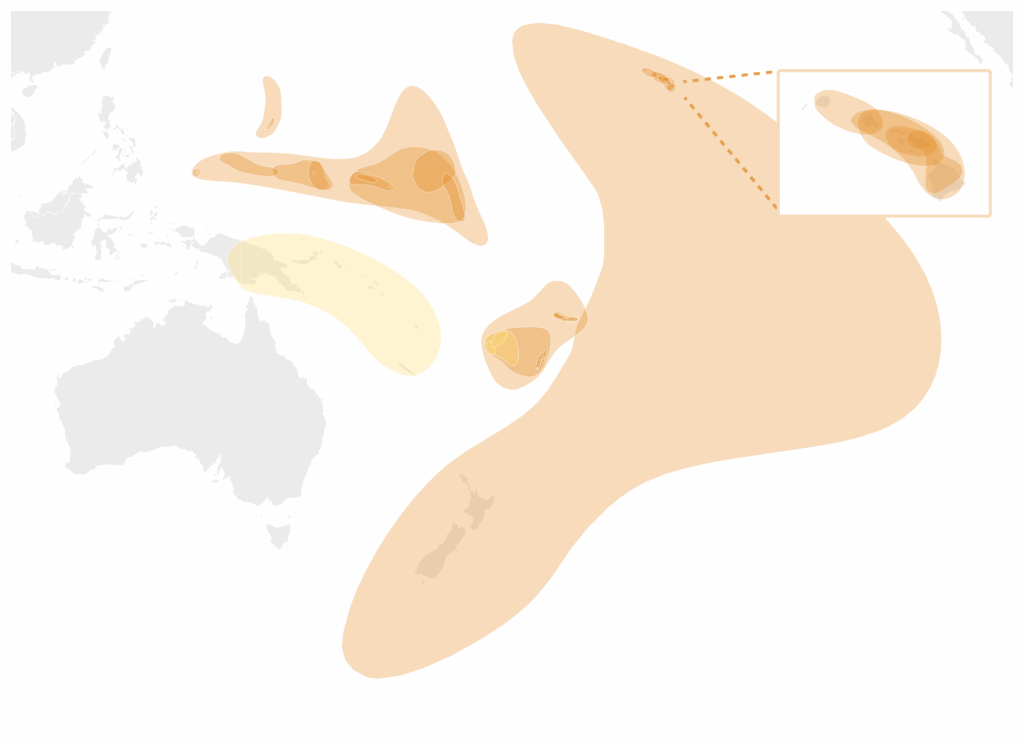
Three Stories Written in DNA
Among the 47 new groups, a few stand out for what they reveal about the region’s history. The Chamorro (or CHamoru) people of Guam and the Northern Mariana Islands have called the islands home for nearly 4,000 years, a heritage visible today in the latte stones, ancient pillars once used to support elevated buildings, that still dot the landscape. 23andMe members with Chamorro ancestry can now see connections not just to the Marianas broadly, but to specific islands like Guam, Rota, Saipan and Tinian.
Farther east, near Pohnpei in the Federated States of Micronesia, lies Nan Madol, a UNESCO World Heritage Site built atop nearly 100 artificial stone islets connected by tidal canals. It served as the ceremonial seat of the Saudeleur dynasty until 1628, and the new Marshallese and Eastern Micronesian Genetic Group traces to this same stretch of ocean.
And Melanesia, which includes Papua New Guinea, the Solomon Islands, Vanuatu and Fiji, is home to a staggering linguistic diversity. Papua New Guinea alone has more than 800 distinct languages, roughly one-eighth of all languages spoken on Earth. Melanesian peoples have lived in the region for tens of thousands of years, making it one of the oldest continuously inhabited parts of the Pacific. 23andMe members can now see if they have connections to specific regions within Melanesia.
A Shared Voyage
Many of these new groups connect to a much older migration story. Around 5,000 years ago, seafaring peoples speaking Austronesian languages began expanding out from what is now Taiwan, eventually reaching the Philippines, Indonesia, Madagascar and the far islands of Polynesia. If you’d like to dig deeper into that journey and how it shaped the genetic map of the Pacific, check out our blog: What Is Austronesian Ancestry?
Many people from Oceania carry DNA connected to both the “Filipino & Austronesian” and “Melanesian” ancestry populations, a reflection of the seafaring Austronesian expansion and the region’s long history of cultural and genetic exchange. This diversity shows up in how some of these new Genetic Groups are organized within the Ancestry Composition report. Genetic Groups normally appear nested under a specific ancestry population; however, some of the new Genetic Groups in this update fall within parts of Oceania where we don’t yet have a dedicated ancestry population. Members from these areas may see their Genetic Groups nested under either the “Filipino & Austronesian” or “Melanesian” ancestry population, depending on which population is most commonly assigned to people who share DNA with that group.
Building a More Complete Picture
Pacific Islander and Native Hawaiian communities have historically been underrepresented in genetic research, which has meant fewer tools and less specific insights for people tracing their roots to the region. Expanding Genetic Groups across Oceania is thanks to the 23andMe members of Pacific heritage who chose to take part in research. There’s more work ahead, and we’re committed to continuing it.
Already a 23andMe member? Sign in to see if you have connections to these new Genetic Groups in your Ancestry Composition report.